
Engineering visualisation has evolved far beyond static drawings and complex technical documents. As engineering systems grow more advanced the challenge is no longer just designing them correctly but communicating them clearly. This is where technical 3D animation plays a defining role in modern engineering visualisation.
Engineering teams today must communicate ideas to multiple audiences including designers project managers, clients, operators, investors and regulators. Each audience has different levels of technical understanding yet all need clarity and confidence. Technical animation bridges this gap by translating engineering logic into clear visual understanding.
The communication challenge in engineering projects
Engineering systems are built on precision interdependence and logic. However they are often explained using CAD files, drawings, charts and manuals that assume deep technical knowledge. While these tools are essential they are not always effective for communication.
This leads to common issues. Non technical stakeholders struggle to understand functionality. Engineers repeatedly explain the same concepts. Misinterpretation causes delays and costly revisions. Decisions are made without full system clarity.
Technical 3D animation addresses these challenges by converting engineering data into structured visual sequences that show how systems behave in real conditions.
What technical animation means in engineering visualisation
In an engineering context technical animation is the accurate visual representation of systems processes and mechanisms using three dimensional models and motion. It is built from real engineering inputs such as CAD data schematics specifications and functional logic.
Technical 3D animation is commonly used to visualise mechanical assemblies and component interaction industrial workflows and process sequences structural behavior and load response fluid airflow and energy movement and installation operation and maintenance procedures.
The objective is not to oversimplify engineering but to simplify how it is understood.
Making complex systems visually understandable
One of the strongest advantages of technical animation is its ability to make invisible processes visible. Internal components hidden inside machinery pipelines or structures can be revealed through cutaway views, transparency and exploded sequences.
With technical 3D animation viewers can see how components interact with each other, understand cause and effect within a system, follow step by step operational logic and visualise processes that occur too fast or too slowly in real life.
This level of visual clarity significantly reduces confusion during design reviews approvals and technical discussions.
Aligning technical and non technical stakeholders
Engineering projects involve people with very different perspectives. Engineers focus on functionality and feasibility while clients and decision makers focus on outcomes safety and value.
Technical 3D animation acts as a shared visual language. Engineers see accurate motion and logic while non technical viewers gain intuitive understanding without needing to interpret complex drawings. This alignment improves collaboration speeds up approvals and reduces communication friction across teams.
Supporting design validation and early decision making
During the design phase visual clarity is critical. Engineering decisions made early have long term impact on cost safety and performance.
By using technical 3D animation teams can validate assembly and installation sequences, demonstrate safety mechanisms and fail scenarios, review spatial constraints and clearances and explain design intent clearly to stakeholders.
This visual validation helps identify issues sooner, reduce late stage changes and increase confidence before physical implementation begins.
Enhancing training and operational understanding
Once an engineering system is built it must be operated and maintained correctly. Traditional manuals and diagrams often fail to communicate procedures effectively especially for complex systems.
Technical 3D animation improves training by showing correct operational workflows, maintenance and servicing steps, safety procedures and risk zones and assembly and disassembly logic.
Visual training content improves comprehension retention and consistency across teams. It also reduces errors, downtime and safety incidents.
Strengthening sales and proposal communication
Engineering driven products and systems can be difficult to sell because they are difficult to explain. Buyers may understand the problem but struggle to visualise the solution.
By using technical 3D animation in sales presentations and proposals companies can clearly demonstrate how the system works, why the design is effective, what differentiates the solution and how it performs in real conditions.
This clarity builds trust shortens sales cycles and positions the engineering solution as well thought out and reliable.
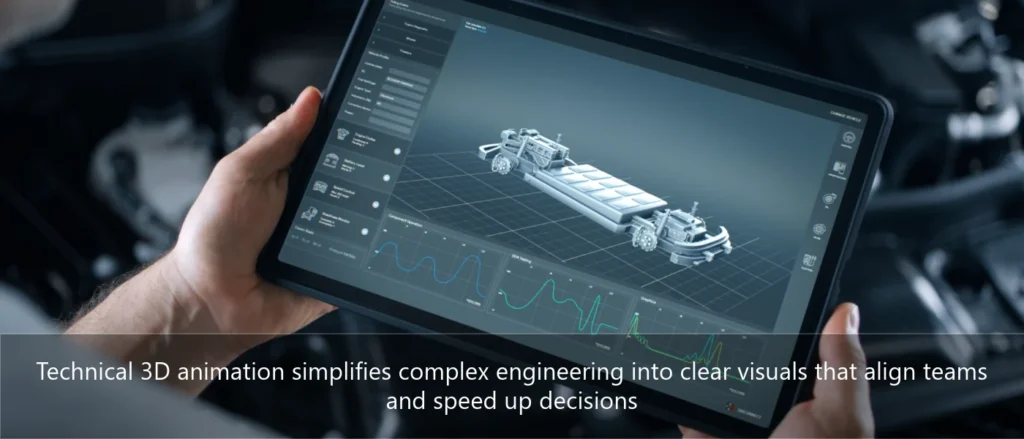
Accuracy first but always with clarity
A common misconception is that technical animation must sacrifice visual quality for accuracy. In reality effective engineering visualisation balances precision with clarity.
High quality technical 3D animation maintains correct scale motion and interaction uses clean lighting and camera movement to guide attention, avoids unnecessary visual distraction and focuses on function over decoration.
When accuracy and clarity work together understanding becomes effortless for all viewers.
Long term value across the engineering lifecycle
One of the most overlooked benefits of technical animation is its long term usability. A single animation can support multiple stages of an engineering project including design reviews and stakeholder approvals, training and onboarding programs, sales and marketing communication and documentation and future upgrades.
Because technical 3D animation is built from real engineering data it remains relevant long after initial delivery. This makes it a strategic asset rather than a one time output.
A foundation for future immersive technologies
Technical animation increasingly serves as the base layer for advanced visual solutions. Accurate 3D assets and animations can evolve into interactive experiences such as AR guided maintenance or VR training simulations.
When technical 3D animation is created with structure and accuracy it becomes future ready allowing organisations to expand into immersive technologies without rebuilding content from scratch.
Why engineering visualisation is moving forward
Engineering communication is shifting from documentation heavy workflows to visual first understanding. As systems become more complex, clarity becomes more valuable.
Technical 3D animation enables engineering teams to communicate intent function and value with confidence. It reduces misunderstanding accelerates decisions and ensures everyone involved shares the same understanding of how a system works.
Reach out to see how we can help your team move forward with confidence.
